

Few words have been diminished by modern organizational language quite as thoroughly as care.
Mention care in a boardroom, and it is often interpreted as a conversation about workplace wellbeing.
Mention it in discussions of leadership, and many assume it refers to interpersonal warmth.
Mention it in technology, and it is frequently relegated to the final section of an ethics checklist, appearing only after efficiency, innovation, and profitability have already shaped the conversation.
Care has gradually become something organizations celebrate rhetorically while treating operationally as optional.
This misunderstanding comes at an extraordinary cost.
Because care is not simply an emotional quality possessed by compassionate people.
Nor is it an act of generosity reserved for exceptional leaders.
Care is a design principle.
It determines how work is distributed.
- How meetings are conducted
- How technologies are deployed
- How policies are written
- How success is measured
- How failure is handled
Ultimately, it determines whether institutions consistently enable people to flourish or quietly exhaust them.
This distinction matters because unhealthy systems rarely emerge from malicious intentions.
More often, they emerge from structures that unintentionally reward extraction over stewardship, speed over reflection, and productivity over sustainability.
Individuals within those systems may care deeply.
Yet their organizations may not be designed to express that care consistently.
The result is a familiar contradiction.
Organizations publish values emphasizing empathy while maintaining workloads that encourage burnout.
They champion inclusion while relying upon communication norms that exclude many forms of thinking.
They celebrate innovation while designing environments where people feel unsafe admitting uncertainty.
The problem is seldom a shortage of caring people.
It is a shortage of caring systems.
Throughout this Canon, one theme has quietly surfaced across every pillar.
Healthy outcomes rarely depend upon extraordinary individuals.
They depend upon ordinary people operating within thoughtfully designed environments.
Perhaps nowhere is that principle more important than here.
Because the future of humane organizations will depend less upon teaching people to care more, and more upon building institutions where care has become part of the architecture itself.
Care Is Different From Kindness 🌿
The distinction between kindness and care may seem subtle at first.
In practice, it changes everything.
Kindness is deeply valuable.
It is the colleague who notices someone struggling and offers help.
The manager who grants flexibility during a difficult week.
The teammate who patiently explains a complicated process.
These moments matter.
They make organizations more humane.
Yet kindness remains largely interpersonal.
It depends upon individual character.
Care operates differently.
Care asks a structural question.
Rather than asking,
"Who needs help today?"
It asks,
"Why does our system require so many people to struggle in the first place?"
Kindness responds to symptoms.
Care redesigns causes.
A thoughtful supervisor may repeatedly stay late helping exhausted employees complete unrealistic workloads.
That is kindness.
A caring organization examines why those workloads became unrealistic and redesigns them before exhaustion becomes routine.
One approach depends upon exceptional people.
The other creates healthier conditions for everyone.
This distinction echoes themes explored throughout the Regeneration pillar.
In The Cost of Speed, we argued that acceleration often creates hidden forms of depletion invisible to conventional performance metrics.
What Ethical Brands Refuse to Measure reminded us that some of the most valuable organizational assets resist easy quantification.
Care belongs among those assets.
It rarely appears neatly within quarterly reports.
Yet its absence eventually becomes visible everywhere else.
- Employee turnover
- Declining trust
- Innovation fatigue
- Customer frustration
- Organizational fragility
These outcomes rarely emerge overnight.
They accumulate gradually, reflecting countless structural decisions made over months or years.
Care, therefore, should never be mistaken for softness.
Properly understood, it is among the most practical forms of organizational intelligence available.
Because systems designed with care consistently reduce unnecessary suffering before it becomes normalized.
That is not sentimentality.
It is good design.
Neurodivergence Reveals System Design 🧠

One of the central arguments throughout this pillar has been that neurodivergence should not be understood merely as a collection of individual differences.
It functions as a lens.
A diagnostic instrument.
An early-warning system capable of revealing organizational assumptions that often remain invisible to everyone else.
This idea first emerged in Neurodivergence as a Sentinel System.
When workplaces consistently overwhelm autistic employees with sensory overload...
When ADHD professionals struggle beneath fragmented workflows...
When highly reflective thinkers become exhausted by constant context switching...
The most important question is not,
"Why can't these individuals adapt?"
It is,
"What have our systems unintentionally optimized for?"
Neurodivergent experiences illuminate friction that frequently affects everyone, even if others have become accustomed to carrying it.
Excessive meetings interrupt deep thinking.
Ambiguous expectations generate unnecessary anxiety.
Poor documentation creates repeated confusion.
Chaotic communication fragments attention.
Constant interruptions erode cognitive quality.
These burdens are not exclusive to neurodivergent professionals.
They simply become visible there first.
This is why neurodivergence offers organizations something profoundly valuable.
Not merely diversity.
Better diagnostics.
Like canaries once carried into coal mines, neurodivergent experiences often reveal environmental conditions long before wider organizational consequences become impossible to ignore.
That insight reframes inclusion entirely.
Accommodation remains important.
But accommodation should not become the endpoint.
The deeper opportunity lies in redesign.
When organizations improve clarity, reduce unnecessary cognitive load, build flexibility into workflows, and create psychologically safer environments, the benefits rarely remain confined to neurodivergent employees.
Everyone thinks more clearly.
Everyone collaborates more effectively.
Everyone carries less unnecessary friction.
Care, viewed through this lens, becomes remarkably practical.
It is not primarily about making exceptions.
It is about improving systems so thoroughly that fewer exceptions become necessary in the first place.
Inclusive organizations are rarely built through isolated accommodations alone.
They emerge because leaders become curious enough to redesign the environments that created exclusion.
Invisible Labor Is Often a Structural Failure ⚠️
Every organization contains work that never appears on a job description.
It is the effort required to interpret vague instructions.
To manage emotional reactions.
To navigate office politics.
To recover concentration after constant interruptions.
To remember unwritten expectations.
To mask uncertainty.
To suppress overwhelm.
To appear perpetually composed.
This invisible labor rarely receives recognition because it is difficult to measure.
Yet it consumes extraordinary amounts of human energy.
Earlier in this pillar, The Hidden Emotional Labor of Being Professional explored how many individuals—particularly neurodivergent professionals—invest significant cognitive resources into appearing acceptable within environments that were never designed with their needs in mind.
Masking becomes work.
Translation becomes work.
Self-monitoring becomes work.
Eventually, survival itself begins to resemble a second occupation.
Likewise, Cognitive Load Is a Leadership Choice argued that complexity is seldom inevitable.
Organizations create cognitive environments through countless decisions about meetings, communication, documentation, priorities, and expectations.
Those decisions either conserve attention or quietly deplete it.
The same principle appeared again in Designing Work for Energy, Not Endurance, where sustainable performance emerged not through asking individuals to become endlessly resilient, but through designing work that respected the limits of human attention.
Taken together, these essays point toward a single conclusion.
Invisible labor is often mistaken for personal resilience.
In reality, much of it reflects structural failure.
When people repeatedly compensate for confusing systems, unclear communication, fragmented workflows, or cultures that discourage authenticity, organizations frequently interpret adaptability as strength.
Yet adaptability can conceal dysfunction just as easily as it demonstrates capability.
The employees who appear to cope most effectively may simply be carrying invisible burdens that others never notice.
Care invites leaders to ask a different question.
Not,
"How can our people become more resilient?"
But,
"What unnecessary burdens have we quietly accepted as normal?"
That shift transforms care from an act of compassion into a method of diagnosis.
It reminds us that healthy organizations should not admire unnecessary endurance.
They should eliminate the conditions that make such endurance necessary.
Because the highest expression of care is not helping people survive poorly designed systems.
It is building systems that no longer require survival in the first place.
Ethical AI Begins With Care 🤖
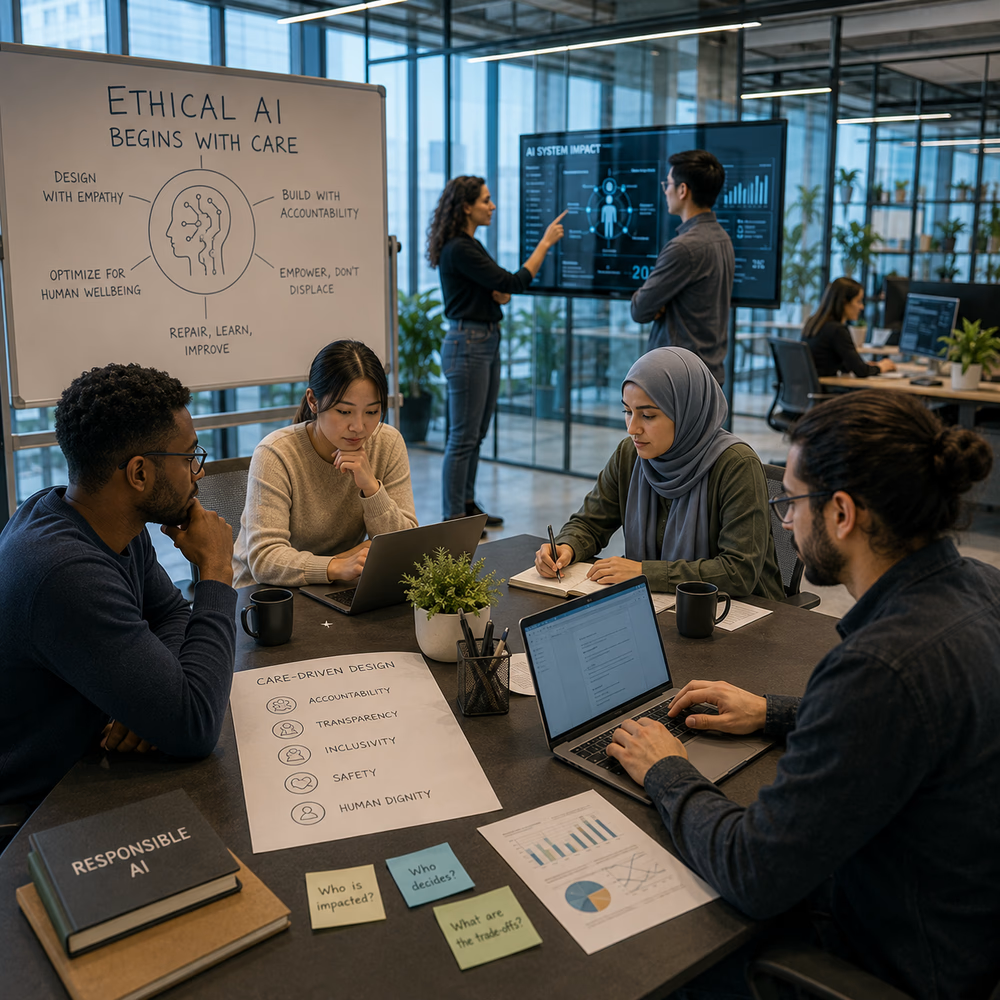
Artificial intelligence is often discussed in the language of capability.
How accurate are the models?
How quickly can they generate answers?
How much productivity can they unlock?
These questions are certainly important.
Yet they are incomplete.
Technology has never been judged solely by what it can do.
Eventually, every important technology is judged by what it repeatedly does to people.
That distinction has shaped the Ethical AI pillar from the beginning.
In The Myth of Neutral Tools, we explored how technologies inevitably reflect the assumptions, incentives, and priorities of the people who build them. AI systems do not emerge from a moral vacuum. Every recommendation, ranking, prediction, and optimization encodes countless human decisions about what matters most.
Likewise, Who Decides What AI Optimizes For? asked a deceptively simple question that continues to echo throughout responsible innovation.
Optimization for whom?
Efficiency for whom?
Accuracy according to whose definition?
These questions are not technical.
They are expressions of care.
Care asks us to notice who carries the burden when systems fail.
It asks whose voices remain absent from the design process.
It asks which trade-offs become invisible once metrics begin replacing human experience.
This perspective reframes ethics entirely.
Ethics is often imagined as a set of constraints applied after innovation has already occurred.
Care begins much earlier.
It shapes the questions we ask before building anything at all.
In Designing AI for Repair, Not Just Efficiency, we argued that responsible technologies should strengthen human capability rather than merely automate human effort.
Repair, after all, is one of care's highest expressions.
It acknowledges that systems inevitably make mistakes.
The measure of responsibility therefore, becomes not whether failure occurs, but whether people are protected when it does.
Similarly, Slow Intelligence in Fast Institutions reminded us that wisdom rarely emerges at the same speed as computation.
Artificial intelligence can accelerate analysis.
It cannot accelerate moral judgment.
That remains deeply human work.
Ultimately, ethical AI is not simply about building systems that function correctly.
It is about building systems that demonstrate care through accountability, transparency, humility, and stewardship.
The most important question may therefore never be,
"Can this AI perform the task?"
But rather,
"Does this system consistently protect the people who must live with its decisions?"
Regeneration Is Institutional Care 🌱
The same principle extends beyond technology.
It shapes every organization that hopes to endure.
Throughout the Regeneration pillar, we challenged a deeply embedded assumption within modern business that success is primarily measured by extraction.
- More output
- More growth
- More efficiency
- More acceleration
Regeneration offered another possibility.
What if healthy organizations measured themselves by what they restored rather than merely what they produced?
That, too, is care.
In The Cost of Speed, we saw how relentless acceleration quietly erodes resilience.
Not because movement itself is harmful, but because systems designed without adequate recovery eventually begin consuming the very resources upon which they depend.
- People
- Trust
- Attention
- Creativity
- Communities
Likewise, Designing for Longevity argued that stewardship requires organizations to think beyond the tenure of individual founders.
The healthiest institutions are designed not simply to succeed today, but to remain worthy of tomorrow.
Care naturally extends across time.
It asks leaders to consider not only present stakeholders, but future generations who will inherit the consequences of today's decisions.
This same philosophy appeared again in What Ethical Brands Refuse to Measure.
Some of the most valuable organizational assets resist quantification.
- Belonging
- Trust
- Psychological safety
- Institutional memory
- Shared purpose
None fit neatly within quarterly reports.
Yet each determines whether organizations remain resilient during periods of uncertainty.
Regeneration, then, is not merely an environmental philosophy.
It is institutional care expressed over long horizons.
Healthy ecosystems replenish themselves.
Healthy organizations should aspire to do the same.
Not because regeneration slows performance.
Because it ensures performance remains possible.
Movements Are Organized Care 🌍
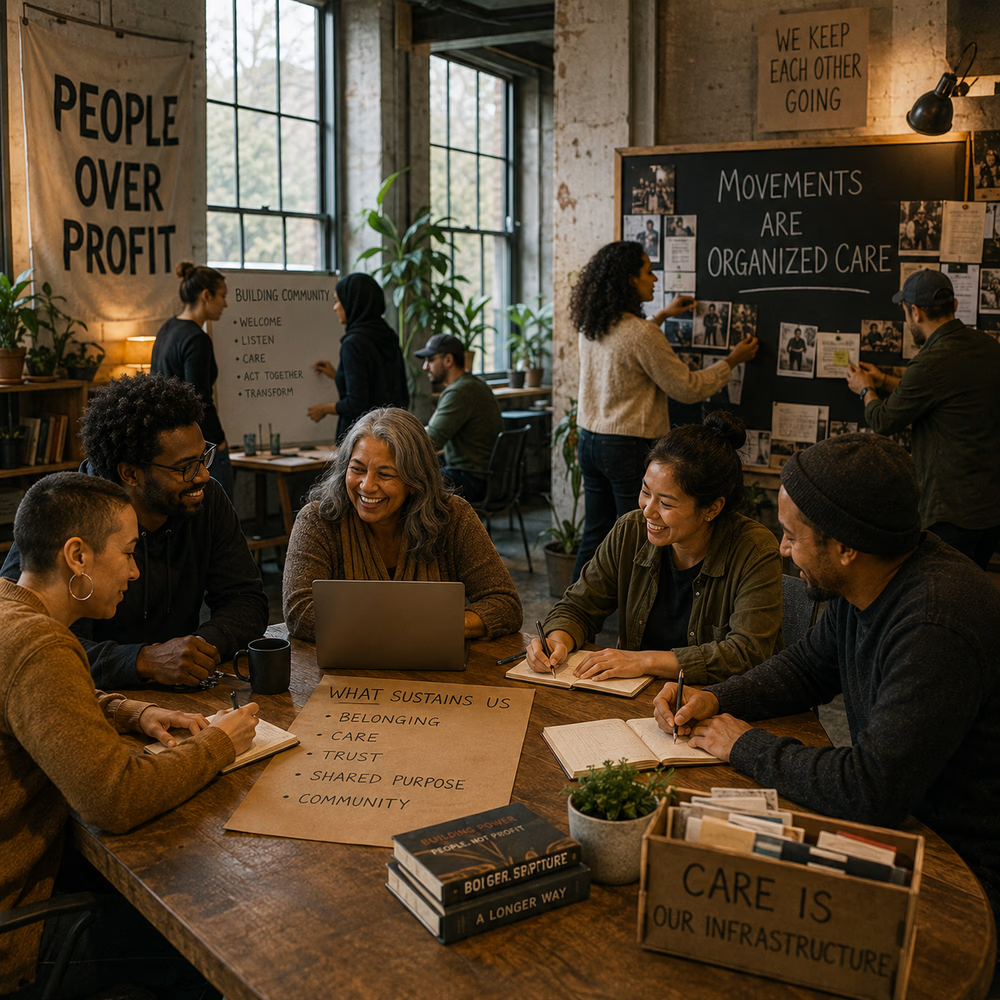
Movements are often remembered through speeches, protests, manifestos, or defining historical moments.
Yet these visible expressions tell only part of the story.
Long before movements transform societies, they transform relationships.
People return because they experience belonging.
Communities endure because someone remembers birthdays, welcomes newcomers, preserves traditions, resolves conflict, documents history, and quietly maintains continuity.
None of these tasks attract headlines.
All of them are acts of care.
Throughout the Movements pillar, we explored how lasting communities rarely depend upon constant expansion.
Why Movements Don't Scale—They Spread argued that genuine cultural change moves through relationships rather than audience acquisition.
Belief Is Built in Repetition, Not Reach reminded us that repeated practice forms identity more reliably than fleeting visibility.
Designing Rituals for Distributed Communities showed how shared habits transform scattered individuals into communities capable of carrying meaning across time and distance.
More recently, The Long Arc of Trust revealed that patience is not merely a virtue.
It is infrastructure.
Trust accumulates because people consistently experience care over time.
Even Why the Internet Still Needs Elders reflected this same idea.
Wisdom survives because someone chooses to preserve it for others.
Care, therefore, is not peripheral to movements.
It is their organizing principle.
Every enduring movement becomes a network of people committed not only to an idea, but to one another.
Ideas may attract attention.
Care sustains participation.
And sustained participation is what ultimately changes culture.
Movements succeed not because they inspire extraordinary moments.
They endure because ordinary acts of care become shared practice.
Leadership as Care Architecture 🛠️

Leadership is often described as vision.
Sometimes as influence.
Occasionally as decision-making.
These descriptions are incomplete.
Every leader is also an architect.
Whether intentionally or not, leaders shape the environments within which other people think, collaborate, create, and recover.
Every calendar reflects priorities.
Every policy distributes opportunity.
Every meeting either conserves attention or fragments it.
Every incentive communicates values.
Every technology either empowers people or quietly redirects power away from them.
Leadership therefore, becomes less about controlling people than designing the conditions under which people are most likely to flourish.
This realization transforms care from aspiration into practice.
Caring leaders ask different questions.
Where is unnecessary friction accumulating?
Which processes create hidden cognitive burdens?
Who remains unheard during decision-making?
Which assumptions have gone unchallenged for too long?
What future consequences are today's efficiencies quietly creating?
These questions are not signs of indecision.
They are evidence of stewardship.
Because leadership is never simply exercised through authority.
It is exercised through architecture.
The healthiest leaders rarely become memorable because they solved every problem personally.
They become memorable because they built systems capable of solving problems wisely even in their absence.
That may be the highest expression of care.
Not making yourself indispensable.
But designing institutions where human dignity, thoughtful collaboration, and shared responsibility continue long after you have stepped away.
Final Reflection: Building Systems Worth Belonging To 🕯️🌌

Across this Canon, we have explored a remarkable range of subjects.
Regenerative strategy.
Neurodivergence.
Artificial intelligence.
Leadership.
Movements.
Culture.
Ethics.
At first glance, they appear to belong to different conversations.
Yet over time, a quieter pattern has emerged.
Every healthy system reduces unnecessary harm before demanding greater resilience.
Every healthy institution protects trust before pursuing growth.
Every responsible technology expands human capability rather than replacing human judgment.
Every enduring movement preserves belonging alongside ambition.
Every thoughtful leader understands that people flourish because environments make flourishing possible.
The thread connecting each of these ideas is care.
Not as sentiment.
Not as charity.
Not as a pleasant organizational value displayed on office walls.
But as structure.
As architecture.
As design.
Perhaps this explains why care has so often been dismissed as soft.
Its greatest achievements rarely announce themselves.
They appear instead as the absence of preventable harm.
The meeting that ends with clarity rather than confusion.
The technology that restores agency instead of removing it.
The workplace where authenticity no longer carries professional risk.
The leader who leaves behind stronger institutions instead of greater dependence.
The community where belonging quietly outlasts the enthusiasm of its founders.
These moments rarely feel dramatic.
Yet civilization itself has always depended upon them.
Because the systems that endure are seldom those built solely for efficiency.
They are the ones people continue choosing to inhabit.
That, perhaps, is the highest measure of good design.
Not that a system functions.
But that human beings can flourish within it.
The future will undoubtedly ask extraordinary things of our institutions.
New technologies.
New economies.
New forms of leadership.
New ways of organizing societies.
Our response will depend less upon whether we possess sufficient intelligence than whether we possess sufficient wisdom to build systems worthy of the people they are meant to serve.
For in the end, care is not the opposite of excellence.
It is the condition that allows excellence to endure.
And the most humane systems may ultimately be remembered not because they demanded extraordinary people...
…but because they consistently enabled ordinary people to do extraordinary things together.
0 Comments
Leave a comment