

Modern society has become remarkably good at accelerating almost everything.
We accelerate communication.
We accelerate commerce.
We accelerate innovation.
We accelerate production.
We accelerate growth.
The language of speed has become the language of success.
Organizations celebrate rapid scaling.
Platforms reward immediate engagement. Markets expect quarterly performance. Leaders are encouraged to move fast, iterate faster, and never lose momentum.
Yet beneath all this acceleration lies one of the most valuable assets any organization, movement, or institution can possess.
Trust.
Unlike almost everything else in modern business, trust refuses to hurry.
It develops quietly.
It grows through consistency rather than intensity.
It compounds through repeated experience rather than isolated achievements.
And perhaps this is why trust feels increasingly rare.
We live in an economy optimized for speed while depending upon a social currency that operates according to entirely different rules.
The future may belong not to those who move fastest, but to those willing to earn trust patiently enough for it to become self-sustaining.
Trust Is Built in Time, Not Transactions 🌱

Trust is often spoken about as though it were an outcome.
In reality, it is a process.
People rarely decide to trust because of a single impressive interaction.
Instead, trust develops through patterns.
It grows when words consistently align with actions.
When promises become habits.
When reliability survives inconvenience.
This distinction matters because reputation and trust are not identical.
Reputation can be influenced by marketing.
Trust cannot.
Trust emerges through repeated evidence.
As explored in Belief Is Built in Repetition, Not Reach, repetition is far more powerful than isolated visibility.
The same principle applies here.
Every dependable interaction becomes another thread woven into a relationship.
Over time, those threads become remarkably difficult to break.
Conversely, trust rarely disappears because of one mistake.
It erodes when inconsistency becomes a pattern.
Patience matters because trust is cumulative.
Like interest, its greatest strength lies in its ability to compound.
Why Modern Institutions Keep Choosing Speed 🚀
If trust grows slowly, why do so many organizations continue prioritizing speed?
Part of the answer lies in measurement.
Speed is visible.
Organizations can quantify:
- Response times
- Delivery schedules
- Quarterly growth
- Conversion rates
- Productivity metrics
- And engagement statistics
Trust is different.
Its growth often remains invisible while it is forming.
This creates a dangerous temptation.
Institutions begin optimizing for what they can measure rather than what they ultimately depend upon.
This tension echoes The Cost of Speed, where acceleration promised efficiency while quietly eroding resilience.
The same dynamic applies to trust.
Organizations frequently mistake visible activity for meaningful progress.
Yet customers, employees, and communities often judge organizations according to entirely different criteria.
They remember consistency.
They remember fairness.
They remember whether leaders behaved responsibly when circumstances became difficult.
Trust accumulates in moments that rarely appear on dashboards.
Leadership Is a Long-Term Promise 🤝

Leadership is often evaluated through vision.
Yet trust is built through follow-through.
People rarely remember every speech a leader delivers.
They remember whether that leader remained consistent when circumstances changed.
Integrity is not demonstrated during moments of convenience.
It becomes visible during moments of pressure.
This insight builds naturally upon What Comes After Thought Leadership?
Thought leadership introduces ideas.
Moral leadership lives those ideas repeatedly.
The difference is subtle but profound.
One attracts attention.
The other earns confidence.
Trust transforms leadership from persuasion into credibility.
And credibility cannot be manufactured.
It must be accumulated.
Every decision becomes a promise about future behavior.
Every fulfilled promise strengthens the next.
Movements Travel at the Speed of Trust 🌍
Healthy movements rarely spread because their messages are persuasive alone.
They spread because relationships become trustworthy.
This distinction has appeared throughout the Movements pillar.
Why Movements Don't Scale—They Spread argued that enduring communities expand through participation rather than audience acquisition.
Designing Rituals for Distributed Communities showed that shared practices transform connection into belonging.
Why the Internet Still Needs Elders reminded us that continuity depends upon people willing to preserve wisdom across generations.
Trust connects all three.
Communities do not simply exchange information.
They exchange confidence.
Every healthy movement eventually becomes a network of trusted relationships capable of carrying ideas farther than any individual leader ever could.
Movements spread because trust becomes transferable.
And transferred trust is among the most powerful forms of social capital humanity possesses.
AI, Institutions & the Fragility of Trust 🤖

Artificial intelligence introduces new dimensions to trust.
Organizations increasingly ask people to rely upon systems making recommendations about:
- Hiring
- Healthcare
- Education
- Finance
- Communication
- And governance
Technical performance certainly matters.
But trust depends upon something deeper.
People also ask:
Who designed these systems?
Whose values shaped them?
Who remains accountable when mistakes occur?
These questions echo themes explored throughout the Ethical AI pillar.
In The Myth of Neutral Tools, we examined how technologies inevitably embed human assumptions.
Slow Intelligence in Fast Institutions argued that wisdom requires institutional environments capable of thoughtful reflection.
And What Future Generations Will Ask About Our AI Choices challenged us to think beyond deployment toward inheritance.
Transparency may help establish trust.
Stewardship sustains it.
Because trust in technology ultimately depends upon trust in the institutions responsible for it.
Psychological Safety Is Trust Made Visible 🧠
Trust does not influence only customers or communities.
It shapes workplaces as well.
Innovation requires people willing to offer imperfect ideas.
Learning requires people willing to admit uncertainty.
Inclusion requires people willing to reveal aspects of themselves that may not fit conventional expectations.
None of these become possible without trust.
This insight connects deeply with the Neurodivergence pillar.
In The Hidden Emotional Labor of Being Professional, we explored how many workers expend extraordinary energy masking parts of themselves in environments they do not fully trust.
Designing Work for Energy, Not Endurance argued that sustainable performance depends upon renewal rather than constant extraction.
Cognitive Load Is a Leadership Choice demonstrated that leaders shape the environments within which thinking occurs.
Trust underpins each of these arguments.
People think more creatively when they feel psychologically safe.
They collaborate more openly when mistakes become opportunities for learning rather than punishment.
They contribute more fully when authenticity no longer carries excessive professional risk.
Trust is not merely emotional comfort.
It is cognitive infrastructure.
Trust Compounds Like Regeneration 🌱
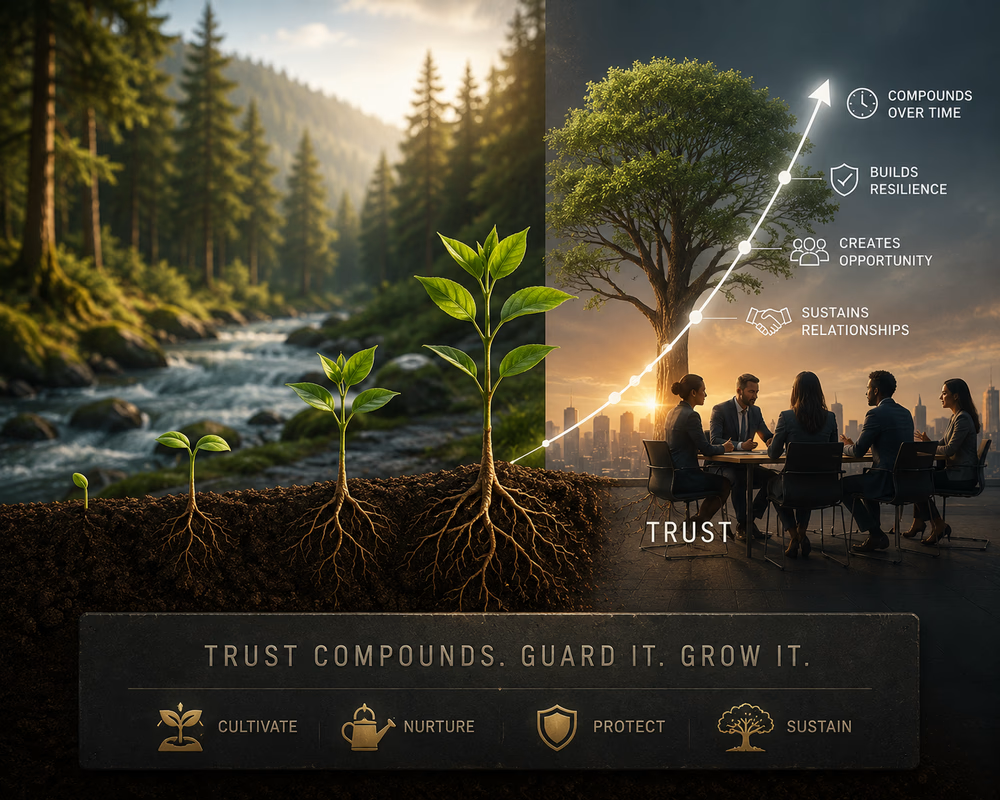
Healthy ecosystems reveal an important lesson.
Resilience develops gradually.
Forests mature over decades.
Soils regenerate season by season.
Rivers carve landscapes through persistence rather than force.
Trust behaves similarly.
It compounds quietly.
This mirrors themes explored throughout the Regeneration pillar.
Designing for Longevity argued that stewardship creates institutions capable of outlasting founders.
What Ethical Brands Refuse to Measure reminded us that some of the most valuable organizational assets resist quantification.
When Best Practice Becomes Ethical Risk challenged us to examine inherited assumptions before repeating them indefinitely.
Trust belongs among these forms of regenerative capital.
It cannot simply be extracted.
It must be cultivated.
And once damaged, rebuilding it often requires considerably more patience than creating it initially.
Organizations frequently underestimate this asymmetry.
Trust may take years to establish.
It can disappear within moments.
The wisest institutions never treat it as expendable.
Final Reflection: The Longest Investment 🕯️🌌
Organizations spend enormous effort searching for competitive advantage.
They pursue:
- Better technologies
- Larger markets
- Faster growth
- Stronger brands
- And more efficient systems
All of these have value.
Yet none may prove as enduring as trust.
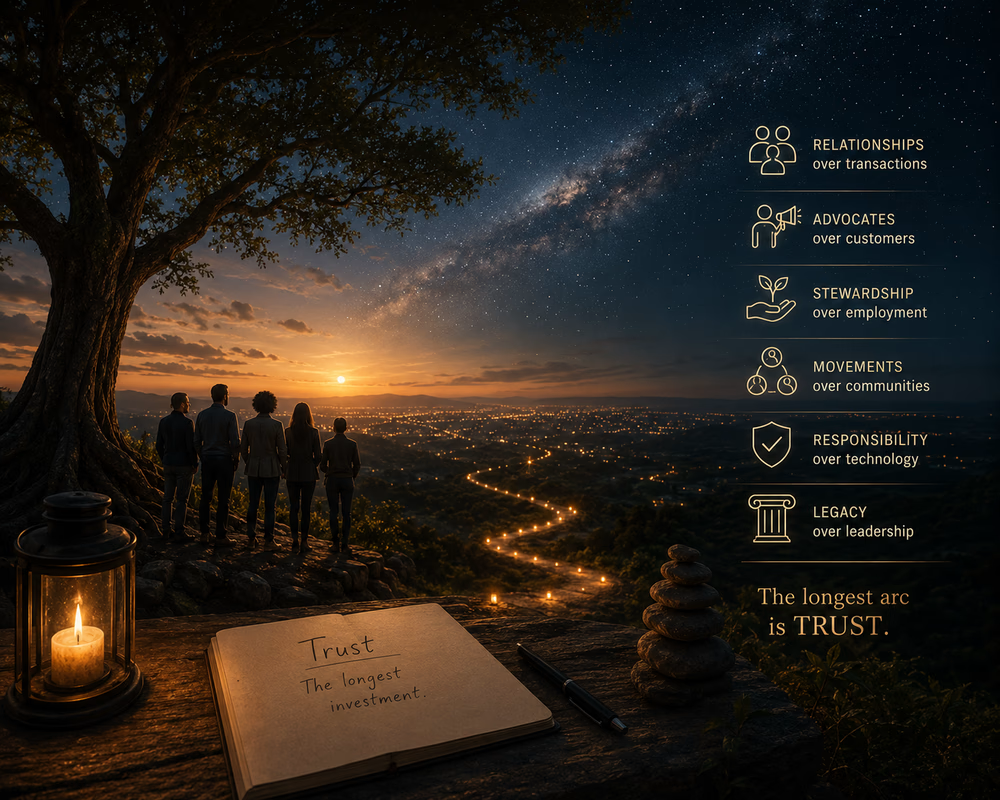
Because trust transforms isolated transactions into lasting relationships.
It transforms customers into advocates.
Employees into stewards.
Communities into movements.
Technology into responsibility.
Leadership into legacy.
The longest arc in leadership is not growth.
It is trust.
And unlike almost everything else modern organizations pursue, trust becomes more valuable the longer we are willing to earn it.
Perhaps this is why patience remains one of the most underestimated strategic capabilities of our time.
Not because patience guarantees success.
But because the things most worth building—healthy organizations, ethical technologies, resilient communities, and regenerative cultures—refuse to be rushed.
In the end, the future may remember neither who moved first nor who grew fastest.
It may remember those who proved, patiently and consistently, that they could be trusted.
Because trust is not merely the reward for building good systems.
It is the quiet foundation upon which every truly human system is built.
0 Comments
Leave a comment