

Professionalism is often described as composure.
Respond promptly. Stay calm. Meet deadlines. Sound reliable. Keep emotions contained.
In digital economies especially, professionalism is communicated through tone as much as output: the polished email, the reassuring message, the steady cadence of availability.
For many neurodivergent people, however, professionalism is not merely conduct.
It is continuous emotional regulation.
It is monitoring facial expressions during calls, scripting responses before meetings, suppressing overwhelm, translating internal chaos into socially acceptable calm, and maintaining predictability even while mentally exhausted.
The modern workplace often rewards those most capable of making distress invisible.
This invisibility carries a cost.
And nowhere is that cost more difficult to absorb than in the gig economy, where continuity depends heavily on perception.
Freelancers, creators, and contractors are expected to remain consistently reachable, emotionally manageable, and perpetually functional.
Human interruption becomes economically dangerous.
The emotional labor of appearing “fine” is rarely recognized as labor at all.
Emotional Labor Beyond Customer Service 🧠
The phrase emotional labor is often associated with customer-facing work: smiling politely, maintaining warmth, managing interactions professionally.
But emotional labor extends much further than friendliness.
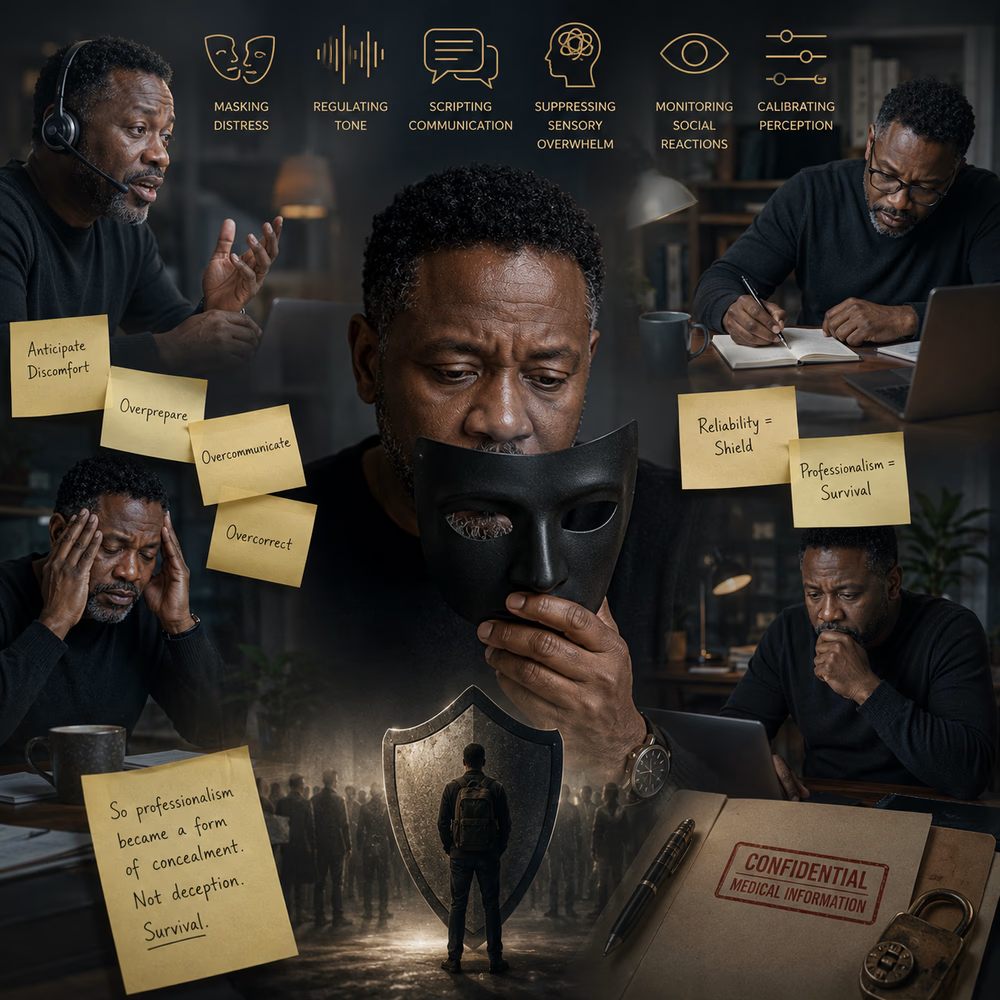
For neurodivergent workers, emotional labor can include:
- Masking distress
- Regulating tone
- Scripting communication
- Suppressing sensory overwhelm
- Monitoring social reactions
- And constantly calibrating how one is perceived
Over time, these behaviors become adaptive survival strategies.
Many neurodivergent professionals become exceptionally skilled at predictability precisely because unpredictability feels unsafe.
They learn to anticipate discomfort before it emerges visibly.
They overprepare, overcommunicate, and overcorrect.
Reliability becomes not only a professional expectation, but a shield against stigma.
This is particularly true for people living with heavily misunderstood conditions such as schizophrenia, where disclosure can carry profound professional risk.
For decades, I carried a quiet apprehension around employers and clients discovering my diagnosis.
The fear was not irrational.
Modern work culture often claims to value mental health while still rewarding uninterrupted performance above all else.
So professionalism became a form of concealment.
Not deception.
Survival.
The Gig Economy and the Fear of Disappearing ⚠️
Traditional employment systems, imperfect as they are, at least imply some degree of continuity.
Freelance ecosystems often do not.
Gig economies are structured around responsiveness, momentum, and constant visibility.
Relationships are frequently transactional, accelerated by platforms and compressed timelines.
The independent worker becomes simultaneously autonomous and precarious.
In such environments:
- Silence can look like unreliability
- Delayed responses can resemble disengagement
- Interruption can trigger replacement
The market rarely pauses long enough to investigate context.
This creates a quiet but powerful fear among many freelancers: the fear of disappearing.
Not physically. Economically.
Clients move on. Projects shift elsewhere. Attention dissolves.
In economies optimized for speed, continuity becomes fragile.
The psychological consequence is profound. Many independent workers internalize the belief that they must remain perpetually available to remain professionally relevant at all.
Breakdown, Silence & Market Amnesia 🕯️
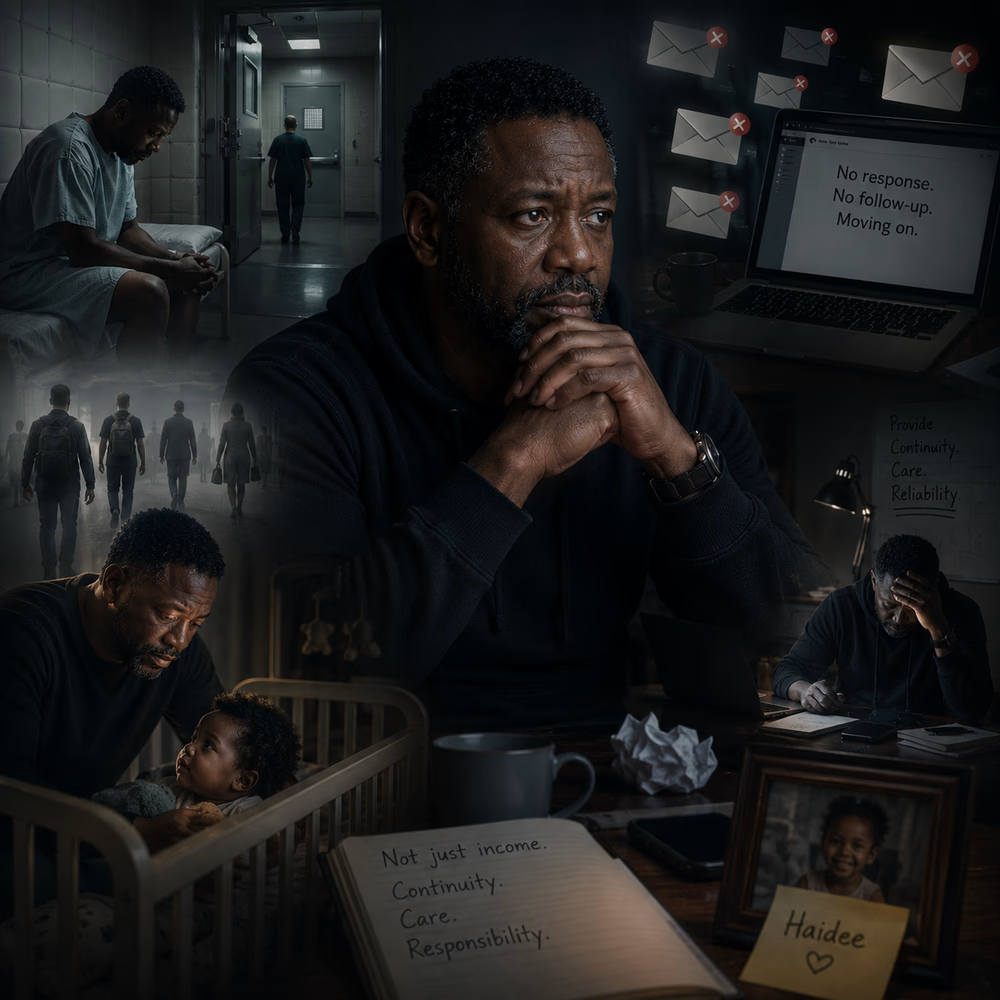
Roughly two years ago, I experienced a psychiatric breakdown that resulted in my temporary incarceration in a mental health unit for two weeks.
During that time, I was effectively incommunicado.
Clients who expected replies, drafts, revisions, and continuity instead encountered silence.
One by one, many disappeared.
Not maliciously. Not even dramatically. They simply moved on.
At the time, what struck me most was not anger.
It was how quickly digital trust could evaporate once continuity broke.
In freelance economies, reliability is often inferred through uninterrupted presence.
The moment that presence disappears, relationships become vulnerable to erosion.
The collapse of workflow became inseparable from another fear: responsibility.
My daughter Haidee-Brianna had just entered the earliest years of her life.
The anxiety was not only about income.
It was about continuity, care, and the terrifying possibility of becoming unreliable to those who depended on me most.
What I experienced was deeply personal. But it also revealed something structural.
Modern gig economies are remarkably efficient at extracting productivity from individuals while remaining poorly equipped to accommodate human interruption, especially psychological crisis.
The worker is expected to remain visible.
The system itself rarely reciprocates with enduring relational memory.
Trauma and the Architecture of Masking 🎭
Long before breakdown occurs, many neurodivergent people have already spent years learning how to disappear inside professionalism.
Masking is not simply imitation. It is often trauma adaptation.
It can manifest as:
- Hyper-professional communication
- Excessive politeness
- Perfectionism
- Emotional neutrality
- Relentless reliability
- Or chronic self-monitoring
Some individuals become extraordinarily polished because unpredictability has historically been punished.
They learn that employability often depends less on authenticity than on emotional manageability.
The tragedy is that workplaces frequently reward the symptoms of survival while ignoring the cost of producing them.
A worker praised for calmness may actually be exhausted from suppressing panic.
Someone admired for professionalism may be carrying an extraordinary cognitive strain simply to maintain social equilibrium.
The labor remains invisible because invisibility itself is part of the performance.
Solopreneurship and Reclaimed Agency 🌱
Over time, however, my relationship with work began to change.
Moving deeper into solopreneurship and creator-centered work did not eliminate vulnerability, instability, or pressure.
But it altered the terms of negotiation.
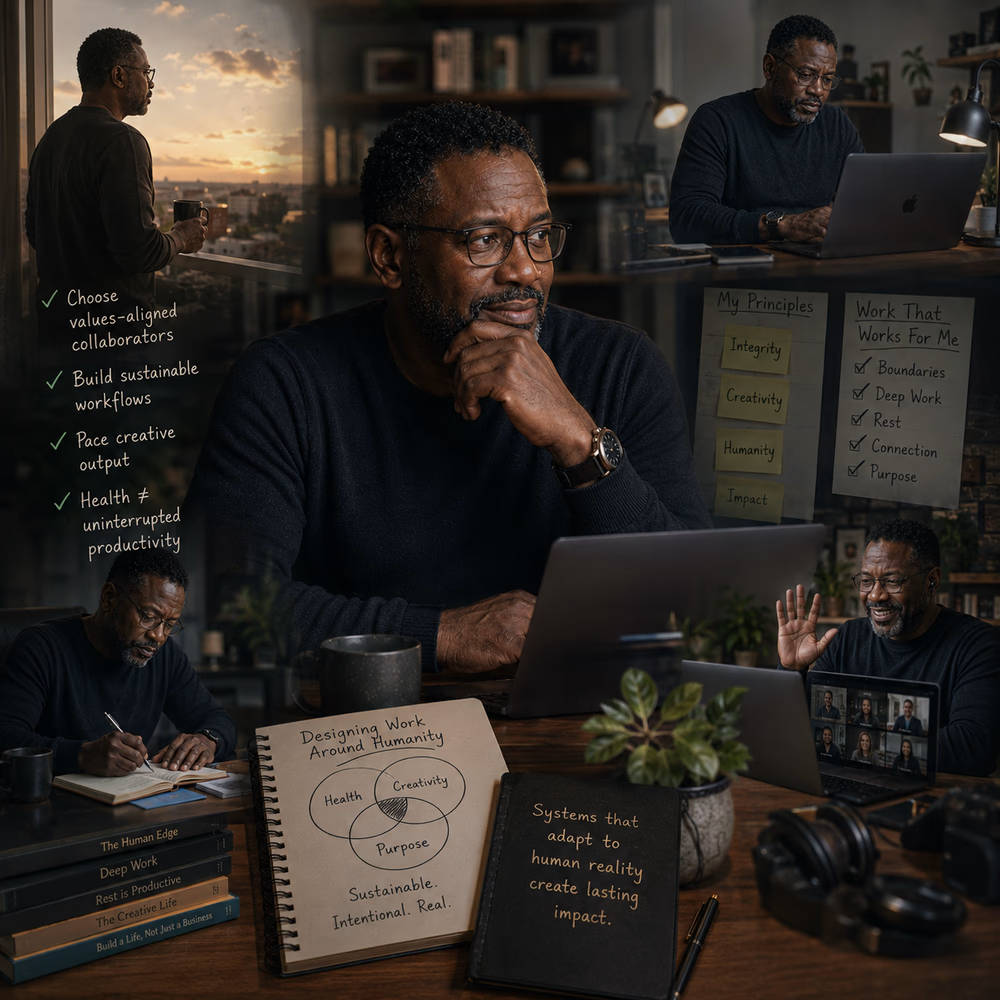
For the first time, I possessed greater agency over who I worked with, how I structured projects, and what forms of disclosure felt safe.
This shift mattered enormously.
Agency does not mean the absence of fragility.
It means the ability to design systems around one’s humanity rather than endlessly concealing it.
I became more intentional about:
- Choosing values-aligned collaborators
- Building sustainable workflows
- Pacing creative output
- And recognizing that uninterrupted productivity is not the same as health
In many ways, this transformation mirrors a broader principle explored throughout the JBN Canon:
Systems become more humane when they adapt to human reality instead of demanding perpetual self-erasure in return for participation.
Professionalism Reimagined for Neurodivergent Workers 🔄
Perhaps the deepest problem is not that modern professionalism asks people to work hard.
It is that it often asks them to compress their humanity into acceptable formats.
Professionalism has become associated with:
- Emotional neutrality
- Uninterrupted output
- Permanent responsiveness
- And the suppression of visible struggle
But healthier systems might define professionalism differently:
- Accountability rather than perfection
- Honesty rather than performance
- Sustainable reliability rather than endless availability
This reimagining becomes especially important in the age of AI-assisted work.
For many neurodivergent professionals, ethical AI tools can function as forms of cognitive support rather than replacement.
AI-assisted workflows can reduce executive-function overload, assist with ideation, organize fragmented thinking, streamline drafting, and lower the invisible emotional friction involved in communication and task management.
In my own experience, AI-supported workflows dramatically expanded my capacity to sustain creative and strategic work after periods of instability.
They did not replace creativity.
They stabilized continuity around it.
This distinction matters.
The healthiest use of AI is not to demand superhuman productivity from already exhausted workers.
It is to reduce unnecessary cognitive strain so people can participate more sustainably and more honestly.
This is where the Neurodivergence pillar intersects naturally with the Ethical AI & Human Systems work of the JBN Canon.
Technology should not merely optimize labor extraction.
It should help build systems that accommodate human variability, recovery, and cognitive diversity.
Ethical AI, at its best, becomes adaptive infrastructure: not a machine demanding perfection, but a tool supporting continuity.
Professionalism, then, no longer needs to mean disappearing inside performance.
It can mean building systems where people remain recognizably human while still being trusted to contribute meaningfully.
Toward More Humane Work Systems 🛠️
Healthier work cultures will require more than wellness language.
They will require structural redesign.
Humane systems would:
- Recognize psychological interruption as part of human reality
- Measure trust over time rather than uninterrupted responsiveness
- Allow selective transparency without punishment
- And prioritize sustainable productivity over perpetual acceleration
Most importantly, they would stop treating vulnerability as evidence of incompetence.
The future of work cannot be built solely around optimization metrics.
It must also account for recovery, adaptability, and care.
Because some of the most capable people in modern economies are expending enormous unseen energy simply trying to appear unaffected by pressures that would overwhelm almost anyone.
Final Reflection: The Cost of Looking “Fine” 🕯️
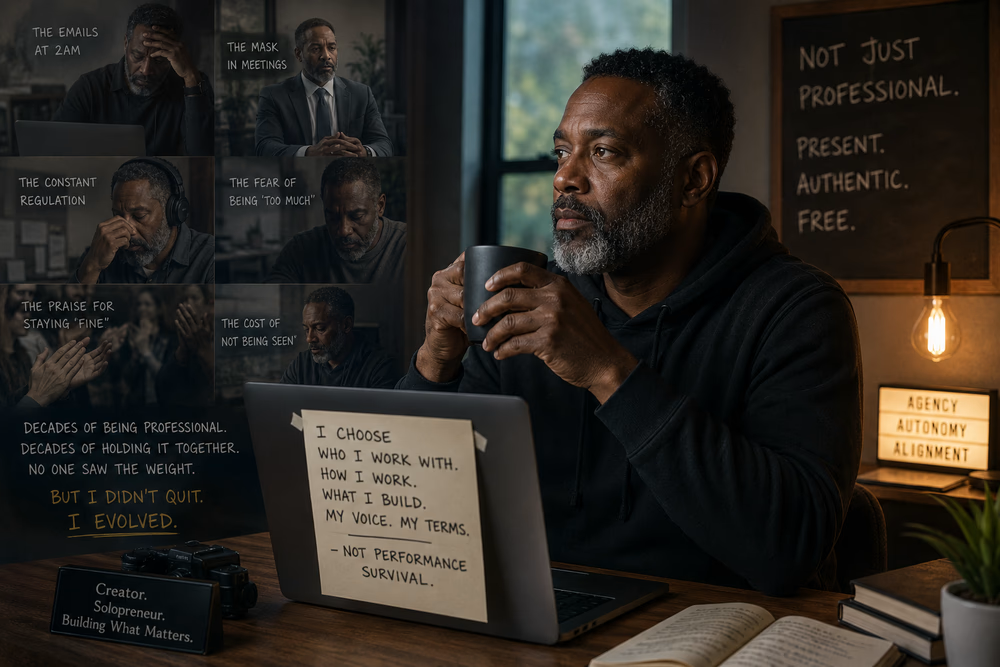
Many people praised as professional are carrying invisible emotional loads.
The calm email. The polished proposal. The composed meeting voice.
These things often conceal extraordinary effort: the constant regulation required to remain employable in systems that punish interruption.
For neurodivergent workers especially, professionalism can become less about excellence and more about concealment.
But concealment is not sustainability.
The future of work will not improve merely through faster platforms, smarter productivity tools, or more efficient workflows.
It will improve when people no longer feel compelled to disappear inside performance in order to survive economically.
Some of the most exhausted people in modern economies are not those failing to cope.
They are those working hardest to ensure nobody notices they are struggling at all.
0 Comments
Leave a comment