

Across history, survival has often depended on those who noticed danger first.
Before catastrophe became visible, before systems failed spectacularly, there were signals—subtle, embodied, and frequently dismissed.
Some reacted sooner to poisoned air.
Others faltered before contaminated water revealed itself.
These early warnings were not errors in the system.
They were the system’s intelligence, registering stress before collapse became unavoidable.
Neurodivergence belongs in this lineage of early warning.
Too often, heightened sensitivity is mistaken for fragility, and distress is misread as dysfunction.
Yet in many environments, neurodivergent discomfort appears precisely where conditions are becoming unsustainable.
What is experienced as individual strain is often a systemic alarm.
The ethical question, then, is not why some people react sooner, but why societies so often punish the signal instead of investigating the cause.
What Sentinel Species Actually Are 🌍
In ecology and public health, sentinel species are organisms whose responses provide advance warning of environmental danger.
Their value lies in detection—registering harm before it reaches catastrophic scale.
What sentinel species are not is equally important.
They are not disposable probes.
They are not designed to suffer for the sake of others.
In ethical sentinel systems, protection and response are integral.
The signal matters because the life providing it matters.
The moral quality of a sentinel system is therefore revealed not by the presence of early warning, but by how that warning is treated.
Detection without response is negligence. Detection without protection is exploitation.
This distinction is essential when extending the framework to human systems.
The Canary in the Mine: A Misremembered Relationship 🐤
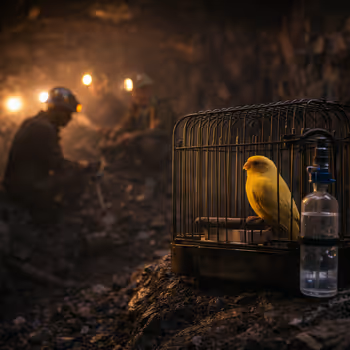
The phrase “canary in the coal mine” is often invoked as shorthand for expendability.
The reality was more complex and more instructive.
Its place in industrial history was not accidental, nor was it born of cruelty.
And its use emerged from deliberate scientific inquiry into how early warning could prevent mass human death.
Sentinel species, long before they entered popular language, were already the subject of careful ethical debate and applied research.
At the turn of the twentieth century, the British physiologist John Scott Haldane—one of the pioneers of respiratory science—proposed the controlled and humane use of canaries in coal mines.
His research demonstrated that the birds’ heightened sensitivity to carbon monoxide could provide miners with advance warning of invisible danger, often minutes before humans would be affected.
Crucially, Haldane’s proposal was not one of sacrifice, but of prevention through early detection.
The theory proved remarkably effective.
Over time, its adoption spread widely across the industrialized West, including the United Kingdom, the United States, Canada, and parts of mainland Europe, where mining communities sought practical ways to reduce fatalities in an era before reliable electronic sensors.
In many operations, canaries were housed in oxygen-equipped cages, removed at the first sign of distress, and frequently treated and rehabilitated.
They were not regarded as expendable instruments, but as partners in survival.
Miners named them, adopted them as mascots, and in some cases mourned them openly—an acknowledgment that lives had been saved because another life was listened to.
This historical detail matters.
The ethical lesson of the canary is not that warning requires sacrifice.
It is that early distress, when respected and acted upon, preserves life.
The failure was never the signal.
The failure would have been ignoring it.
Five Sentinel Species, Five Ethical Lessons 🧭
Across nature and history, sentinel species reveal recurring moral patterns about how societies respond to early warning.
1. Canaries — Immediate Atmospheric Threats 🐤
Canaries reacted quickly to invisible toxins.
Their distress was unmistakable and urgent.
Lesson: Early, embodied signals demand immediate action.
Human parallel: Neurodivergent burnout or sensory overload often appears before systemic collapse becomes visible.
2. Mussels — Slow, Accumulative Poisoning 🌊

Their bodies reveal contamination long before humans notice its effects.
Lesson: Not all danger announces itself dramatically.
Human parallel: Some neurodivergent individuals register long-term cultural or ethical toxicity others normalize as “just how things are.”
3. Dogs — Trained Sensitivity with Protection 🐕
Dogs detect explosives, disease, and radiation with extraordinary accuracy.
Their value is institutionally recognized, and so is their need for care, rest, and protection.
Lesson: Sensitivity is safeguarded when its value is acknowledged.
Human parallel: Neurodivergent strengths are respected only when systems formally recognize and protect them.
4. Pigeons — Dismissed Messengers 🕊️
Once treated as pests, pigeons later proved reliable indicators of air quality and environmental health.
Lesson: Credibility often arrives after damage has already occurred.
Human parallel: Neurodivergent warnings are frequently ignored until crisis retroactively validates them.
5. Rats — Stigmatized Signals of Plague 🐀

Rats signaled the presence of bubonic plague yet were killed rather than heeded. The signal was silenced, and catastrophe followed.
Lesson: Punishing the messenger accelerates disaster.
Human parallel: Pathologizing discomfort instead of addressing its cause leads systems toward collapse.
Three Moral Responses to Sentinels ⚖️
Across these examples, societies tend to respond to sentinels in one of three ways:
- Protection: The signal is respected. The sentinel is safeguarded. Harm is prevented.
- Instrumentalization: The signal is used, but the system remains unchanged. The sentinel is tolerated, not protected.
- Suppression: The signal is dismissed or punished. The sentinel is blamed. Catastrophe follows.
History suggests that failure rarely stems from a lack of warning.
More often, it arises from choosing the wrong response.
Neurodivergent Humans as Early Warning Lives 🧠🚨

Translating this framework to human systems requires care.
Neurodivergent people are not tools.
They are participants embedded within social, cultural, and organizational environments.
Their distress is not data to be extracted, but a signal to be respected.
Common neurodivergent experiences—sensory overload, ethical discomfort, cognitive fatigue—often emerge where pace, pressure, or values have become misaligned with human limits.
These experiences do not obligate endurance.
They obligate investigation.
When systems rely on neurodivergent distress as a warning without altering conditions, they cross an ethical line.
Detection without response becomes exploitation.
The Danger of the “Superpower” Narrative 🦸
There is an understandable temptation to frame neurodivergence as a superpower.
The language is affirming but incomplete.
Romanticizing sensitivity risks glorifying pain.
It can quietly shift responsibility onto those who detect harm first, expecting them to endure more, adapt longer, or suffer silently for the benefit of others.
A sentinel’s worth is not proven by how much damage they can withstand. It is proven by how effectively systems respond to the signal they provide.
Strength lies not in suffering, but in being heeded.
Designing Ethical Sentinel Systems in Human Organizations 🏗️
If organizations benefit from early warning humans, they inherit ethical obligations.
Protection 🛡️
Reduce exposure to chronic overload.
Prevent burnout-by-design rather than celebrating resilience after the fact.
Response 🔁
Treat discomfort as information, not defiance.
Act promptly and visibly on signals received.
Distribution 🌐
Avoid relying on a few individuals to bear the burden of detection.
Build systemic sensing capacity.
Repair 🛠️
Address root causes rather than disciplining messengers.
Change conditions, not just narratives.
These obligations reflect organizational maturity, not individual toughness.
Conclusion: The Signal Is Not the Problem 🕯️

Ecological systems always signal distress before collapse.
Human systems are no different.
The enduring question is never who warned us.
It is why we did not listen.
Neurodivergence does not threaten systems. It reveals their truth.
When treated ethically, early warning lives make survival possible—not through sacrifice, but through clarity.
The danger was never the sentinel.
It was the silence that followed.
0 Comments
Leave a comment