

JBN RESEARCH & GOVERNANCE / 01
Content Performance & Optimization Governance Framework
CPOGF
An evidence-led governance framework for identifying meaningful content-performance signals, locating where constraints occur, diagnosing plausible causes, validating those diagnoses, and selecting proportionate optimization interventions.
Content performance is rarely explained by a single metric.
Search visibility, clicks, engagement, navigation, CTA interactions and enquiries can reveal that something has changed. They do not, by themselves, establish why it changed—or what should happen next.
CPOGF provides a structured method for moving from signal → diagnosis → evidence → intervention → learning.
Metadata:
STATUS: COMPLETE
RESEARCH ARTIFACT
12,000+ WORDS
JBN CONTENT CONSULTANCY
THE COMPLETE RESEARCH ARTIFACT
Read the Content Performance & Optimization Governance Framework
The complete CPOGF artifact is presented here as a research publication for direct reading, with a downloadable PDF available for offline reference.

CPOGF is designed to be examined rather than simply summarized.
The framework brings together performance signals, search evidence, behavioural evidence, architectural context, strategic intent and business considerations to support more disciplined optimization decisions.
CONTENT PERFORMANCE & OPTIMIZATION GOVERNANCE FRAMEWORK
Version: 1.0
Status: Complete
Format: Research Framework / PDF
Having trouble viewing the document?
THE PROBLEM
A Metric Can Tell You Something Changed. It Cannot Always Tell You Why
Content optimization often begins with a metric moving in the wrong direction.

Traffic declines. Impressions fall. CTR weakens. Engagement changes. A CTA receives fewer interactions. Enquiries slow.
These are important signals—but they are not diagnoses.
A decline may reflect changing demand, search behaviour, content alignment, architecture, user experience, measurement conditions, commercial positioning or other contextual factors.
The same symptom can therefore have very different causes.
CPOGF begins from a simple governance principle:
Never optimize the metric. Diagnose the system that generated the metric.
The objective is not to react faster.
It is to diagnose better.
THE GOVERNANCE QUESTION
From “What Changed?” to “What Should We Do About It?”
CPOGF establishes a repeatable method for moving from observed performance signals toward proportionate decisions.

The framework asks:
What is happening?
Identify meaningful deviations from expected performance.
Where is it happening?
Locate the constraint within the broader performance journey.
Why might it be happening?
Examine competing explanations across relevant evidence sources.
What evidence supports the diagnosis?
Validate the strongest explanation rather than treating an initial interpretation as fact.
What intervention is justified?
Select an intervention proportionate to the strength, persistence and significance of the evidence.
What happened afterward?
Re-measure the intended outcome and use the result to inform the next decision.
CPOGF therefore governs the decision process surrounding optimization, not merely the optimization activity itself.
THE JOURNEY
Content Performance Is a Journey, Not a Single Event
A content asset can succeed or encounter constraints at different points in the journey from discovery to meaningful action.

DISCOVER
Can the intended audience discover the content?
VISIT
Does the destination attract the expected audience from relevant sources?
EXPLORE
Does the experience support meaningful engagement and progression?
ACT
Does the user take an appropriate next step?
CONVERT
Does the resulting behaviour contribute to the intended outcome?
Journey statement:
Discover → Visit → Explore → Act → Convert
A useful performance diagnosis therefore asks not simply whether a page received traffic, but where the journey is functioning, where it is constrained, and what the page is actually intended to accomplish.
THE CORE METHOD
Detect → Localize → Diagnose → Validate → Intervene → Re-measure
CPOGF separates observation from interpretation and interpretation from intervention.
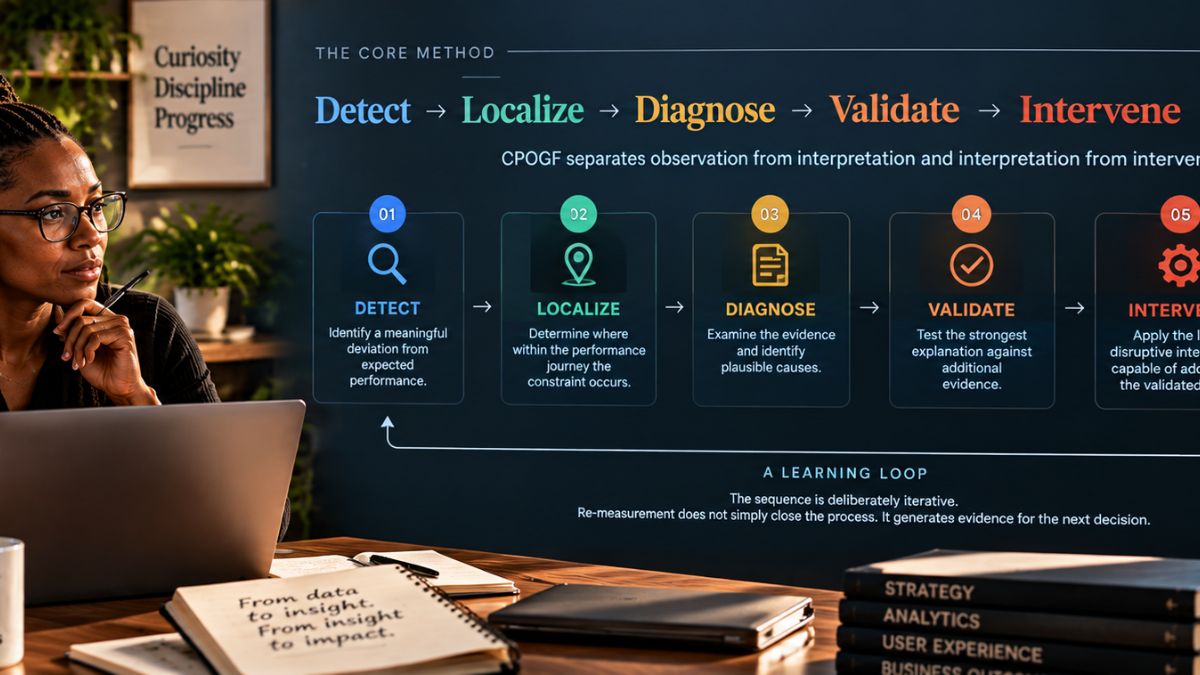
01 — DETECT
Identify a meaningful deviation from expected performance.
02 — LOCALIZE
Determine where within the performance journey the constraint occurs.
03 — DIAGNOSE
Examine the evidence and identify plausible causes.
04 — VALIDATE
Test the strongest explanation against additional evidence.
05 — INTERVENE
Apply the least disruptive intervention capable of addressing the validated issue.
06 — RE-MEASURE
Evaluate what happened after an appropriate observation period.
The sequence is deliberately iterative.
Re-measurement does not simply close the process. It generates evidence for the next decision.
EVIDENCE BEFORE ASSUMPTION
Built from Evidence, Not Assumptions
Performance evidence becomes more useful when different sources are interpreted together.
CPOGF therefore uses an evidence stack spanning the content ecosystem.

SEARCH EVIDENCE
What are people searching for, and how is the ecosystem appearing?
BEHAVIOURAL EVIDENCE
What happens after someone reaches the destination?
ARCHITECTURAL EVIDENCE
How is the asset connected to the rest of the ecosystem?
STRATEGIC EVIDENCE
What is the page actually supposed to accomplish?
BUSINESS EVIDENCE
Does the resulting behaviour contribute to a meaningful organisational outcome?
Google Search Console can provide evidence around search demand, visibility, queries, devices and destinations.
Google Analytics 4 can provide additional evidence around engagement, exploration, pathways and commercial progression.
Neither source should be treated as a complete explanation of user behaviour.Evidence does not eliminate uncertainty.
Good governance makes uncertainty visible—and prevents it from being mistaken for certainty.
DIAGNOSIS
The Same Signal Can Have Different Causes
CPOGF examines performance through multiple diagnostic dimensions rather than assuming that every problem is a content problem.

01 — SEARCH & DEMAND
Is there evidence of demand, discoverability and relevant search visibility?
02 — CONTENT
Does the asset satisfy the intended audience need and perform its defined role?
03 — ARCHITECTURE
Is the asset appropriately connected to the wider content ecosystem?
04 — UX & PATHWAY
Can users understand, navigate and progress through the intended experience?
05 — COMMERCIAL ALIGNMENT
Does the destination support the appropriate business objective and next action?
A performance signal becomes more actionable when these dimensions are considered together.
FROM OBSERVATION TO DECISION
Do Not Confuse the First Explanation with the Right Explanation
A useful optimization process distinguishes what has been observed from what is believed to explain it.

SIGNAL
Something has changed.
DIAGNOSIS
A plausible explanation is identified.
HYPOTHESIS
The explanation is translated into something that can be investigated.
VALIDATION
Additional evidence is examined to determine whether the explanation remains credible.
INTERVENTION
Only then is a change selected.
This distinction is particularly important when several explanations could produce the same symptom.
For example, high impressions and low CTR may warrant investigation—but the signal alone does not establish whether the appropriate response concerns search intent, SERP alignment, positioning, title and description treatment, audience expectations, or another factor.
A metric should trigger investigation, not automatically dictate the solution.
INTERVENTION GOVERNANCE
Not Every Problem Requires a Rewrite
CPOGF establishes an evidence-proportionate approach to intervention.
A weak signal may justify monitoring.
A persistent signal may justify optimization.
A systemic signal may justify structural intervention.
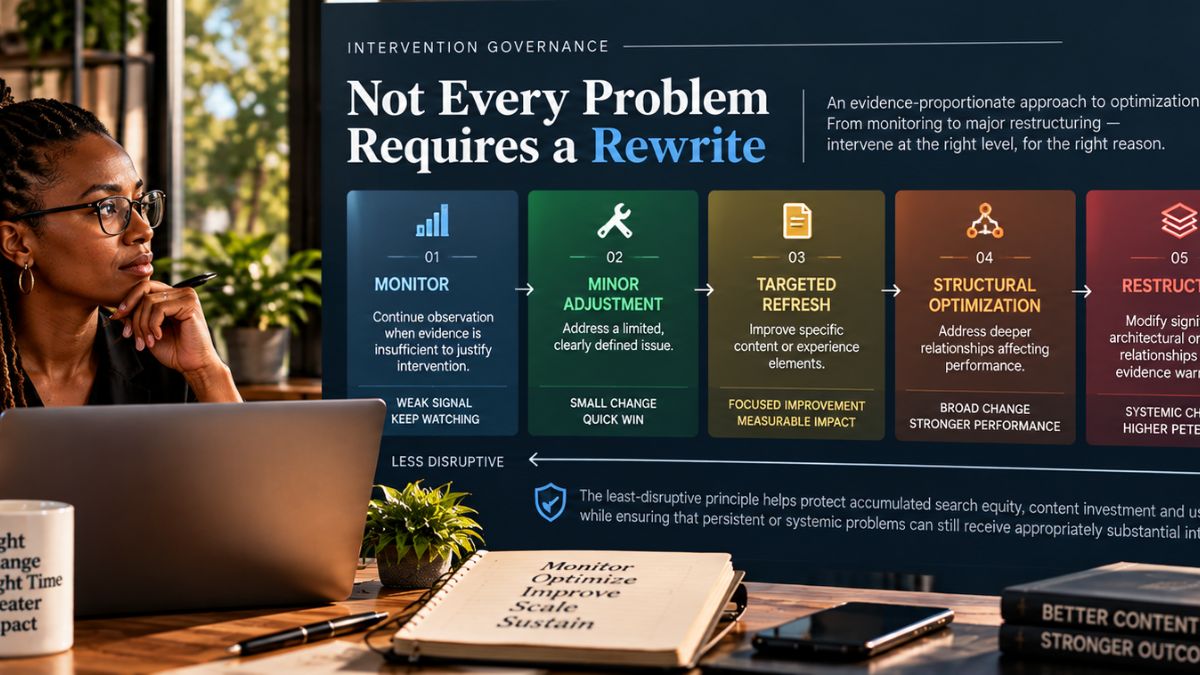
The framework therefore uses an escalation hierarchy:
MONITOR
Continue observation when evidence is insufficient to justify intervention.
↓
MINOR ADJUSTMENT
Address a limited, clearly defined issue.
↓
TARGETED REFRESH
Improve specific content or experience elements.
↓
STRUCTURAL OPTIMIZATION
Address deeper relationships affecting performance.
↓
RESTRUCTURE
Modify significant architectural or content relationships where evidence warrants it.
↓
CONSOLIDATE / REPLACE / RETIRE
Consider major disposition decisions when accumulated evidence supports them.
The least-disruptive principle helps protect accumulated search equity, content investment and user familiarity while ensuring that persistent or systemic problems can still receive appropriately substantial intervention.
MEASUREMENT GOVERNANCE
Measure the Decision, Not Just the Change
Changing a page does not automatically mean the optimization succeeded.
A useful optimization record should preserve the relationship between the original signal, the decision made and the outcome observed.

THE DECISION RECORD
Asset → Signal → Diagnosis → Evidence → Intervention → Expected Outcome → Measurement Window → Result → Next Decision
This creates a record of not only what changed, but why it changed, what outcome was expected and what the evidence subsequently revealed.
CPOGF also distinguishes different levels of measurement:
DISCOVERY
Was the intended audience able to find the asset?
ENGAGEMENT
Did users meaningfully interact with the destination?
INTENT
Did behaviour indicate progression toward the intended purpose?
LEAD ACTION
Did the user complete a meaningful action?
QUALIFIED BUSINESS OUTCOME
Did that action contribute to a meaningful organisational result?
The closer a measurement is to the intended business outcome, the more carefully its interpretation should account for context, attribution and data quality.
BEFORE INTERVENING
Good Decisions Require Trustworthy Evidence
Before interpreting a performance signal, CPOGF places emphasis on the conditions under which the evidence was generated.
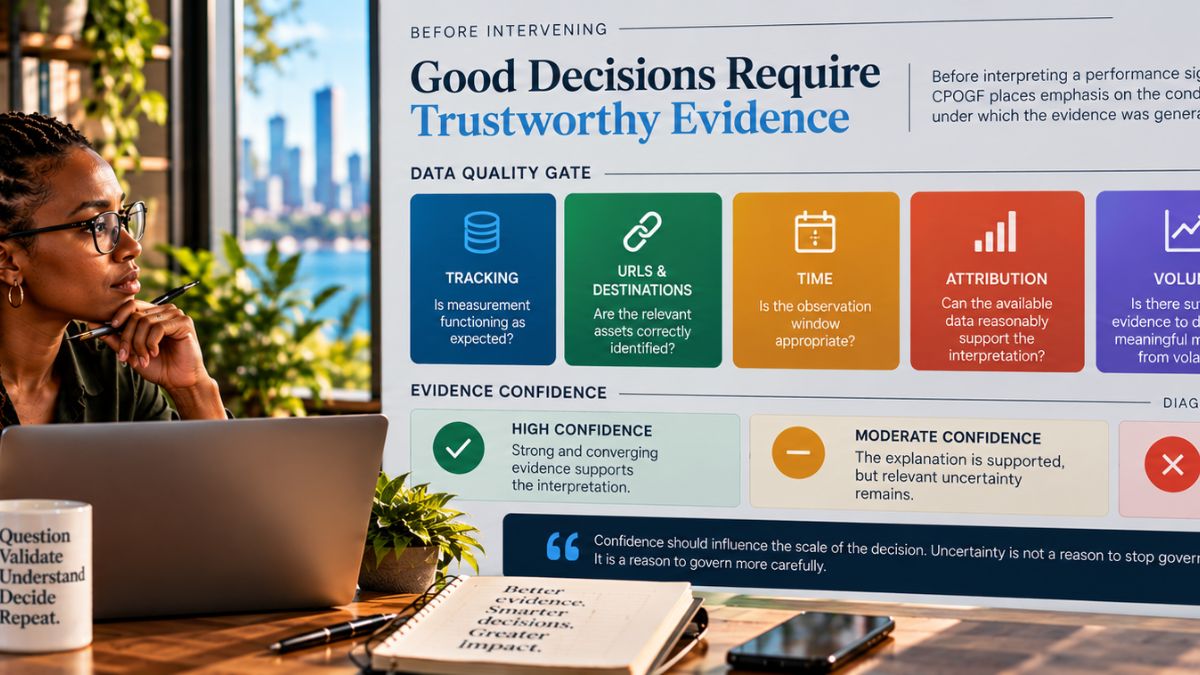
DATA QUALITY GATE
Consider:
Tracking
Is measurement functioning as expected?
URLs & destinations
Are the relevant assets correctly identified?
Time
Is the observation window appropriate?
Attribution
Can the available data reasonably support the interpretation?
Volume
Is there sufficient evidence to distinguish meaningful movement from volatility?
Context
Could seasonality, measurement changes or other external factors affect the observation?
EVIDENCE CONFIDENCE
A diagnosis can carry:
High confidence
Strong and converging evidence supports the interpretation.
Moderate confidence
The explanation is supported, but relevant uncertainty remains.
Low confidence
Evidence is insufficient or competing explanations remain plausible.
Confidence should influence the scale of the decision.
Uncertainty is not a reason to stop governing.
It is a reason to govern more carefully.
LIMITATIONS
Governance Requires Knowing Where the Evidence Stops
Analytics can reveal patterns in content performance. They cannot reliably answer every question a decision-maker may want to ask.
CPOGF therefore treats measurement limitations as part of governance rather than as an afterthought.

AVAILABLE EVIDENCE MAY HELP ESTABLISH
What changed.
Where the change occurred.
When the change occurred.
Which queries, destinations or pathways are associated with the observed pattern.
Whether multiple evidence sources point toward a similar explanation.
AVAILABLE EVIDENCE MAY NOT RELIABLY ESTABLISH
An individual's exact reason for acting.
Genuine underlying intent.
Whether one observed behaviour represents a unique person.
Causation from correlation alone.
The quality of a lead without appropriate business data.
Why a user abandoned a pathway.
The commercial value of an interaction without downstream business evidence.
The purpose of CPOGF is therefore not to manufacture certainty.
It is to create a disciplined decision environment in which evidence, uncertainty and assumptions remain distinguishable.
THE LARGER JBN SYSTEM
CPOGF Is One Layer of a Larger Content Governance System
CPOGF began with a question about content performance.
The work subsequently revealed a broader problem: performance cannot always be understood at the level of an individual URL.
Sometimes the answer lies in architecture.
Sometimes in search intent.
Sometimes in how knowledge is organized.
Sometimes in how educational resources connect to relevant services.
Sometimes in how different page roles should be optimized.
And sometimes in how the entire optimization process is operationalized over time.
This is why CPOGF sits within the emerging six-part JBN governance system.
CPOGF
Performance & Optimization
Governs the interpretation of performance signals and the decisions that follow them.

CASIUXGP
Architecture, Search Intent & UX
Governs relationships between intent, audience need, page role, information hierarchy and progression.

SEO Content Taxonomy & Knowledge Architecture
Knowledge Structure
Governs topics, relationships, hierarchies and discoverability across the content ecosystem.

Toolkit-to-Service Conversion Pathway
Contextual Progression
Governs the relationship between educational resources and relevant commercial pathways.

Content & Commercial Page Optimization
Page-Role Optimization
Governs optimization according to intended purpose, audience, journey stage and business objective.

Digital Content Optimization & Measurement Operating Procedure
Operationalization
Translates governance principles into repeatable planning, implementation, measurement, documentation and review.
Together, these frameworks move the question beyond:
“How do we optimize this page?”
toward a more consequential question:
“How do we govern a content ecosystem that can learn from its own evidence?”
Explore the wider system