
Historical fiction is often expected to reconstruct the past through narrative alone.
Yet, while writing Echoes of Valor, I discovered that some truths—especially those rooted in memory, spirituality, and cultural transformation—resist explanation through prose.
They ask instead to be felt.
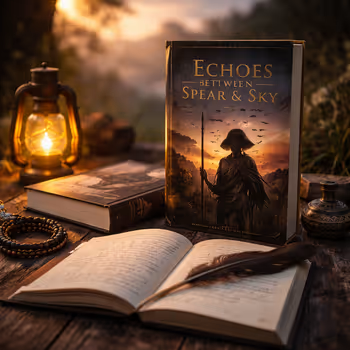
That realization led to the creation of Echoes Between the Spear & the Sky, a lyrical companion to the novel and the first installment in what I now call the Mekatilili Trilogy: Lyric Companion Series.
The Moment I Realized Prose Was Not Enough 📖➡️🎶
While drafting the early chapters of Echoes of Valor, I began inserting short poems at pivotal moments.
Initially, they were meant as stylistic interludes: brief pauses between movements of the narrative.
But over time, those verses began doing something unexpected.
They spoke where narration could not.
They gave voice to:
- The inner awakening of Mnyazi before she becomes Mekatilili.
- The moral uncertainty of young men like Dyeka, caught between honor and violence.
- The spiritual grammar of a world shaped by ancestors, land, and communal identity.
- The emotional atmosphere of a society standing unknowingly at the edge of colonial disruption.
I came to understand that these poems were not decorative.
They were interpretive.
They became a parallel language through which the story could breathe.
Poetry as Historical Reflection, Not Escape 🌍

African history, particularly when transmitted through oral traditions, has always lived at the intersection of narrative, rhythm, and philosophy.
Praise songs, invocations, laments, and ritual speech have long carried meaning alongside events themselves.
In that sense, writing this 20-poem collection was less an experiment and more a return to an older storytelling logic—one in which:
History is remembered not only through what happened, but through how it was experienced.
The poems in Echoes Between the Spear & the Sky attempt to inhabit that experiential space.
They explore the emotional and ethical groundwork beneath the visible events of the novel, offering readers another way to enter the world of late nineteenth-century East Africa.
Why a Companion Series Matters to the Trilogy 🔱
This poetry collection is not a standalone detour.
It is structurally tied to the unfolding arc of the Mekatilili wa Menza Trilogy.
Each novel will be accompanied by its own lyrical counterpart:
Echoes Between the Spear & the Sky (Echoes of Valor)
A meditation on awakening, identity, mentorship, and the fragile moral landscapes that precede resistance.
Songs of Iron & Dust (Daughter of War)
Will lean into martial, communal, and movement-driven poetry—capturing the rhythms of mobilization, sacrifice, and leadership as resistance takes form.
Ashes & Afterlight (Curtain Falls)
Will reflect on legacy, aging, remembrance, and the afterlives of struggle; how history settles into memory.
Together, these companion works aim to illuminate dimensions that narrative fiction alone cannot fully articulate: silence, doubt, ritual, and transformation across generations.
Writing Between Scholarship and Imagination ✍🏾
One of the central challenges of African historical fiction is the scarcity—or fragmentation—of archival documentation.
Much must be reconstructed through oral history, cultural knowledge, and careful imagination.
Poetry allows space for that uncertainty.
It does not claim to document; it seeks to resonate.
It does not assert; it invites contemplation.
Through verse, I can approach historical consciousness with humility—acknowledging what is known, what is inherited, and what must be interpreted with care.
An Invitation to Read the Trilogy Differently 🌅
My hope is that readers encounter these companion books not merely as supplements, but as another lens through which to engage the narrative universe.
They are pauses for reflection, spaces to listen more closely to what lies beneath action and dialogue.
If Echoes of Valor tells the story,
Echoes Between the Spear & the Sky listens to its heartbeat.
Begin the Journey 🔗
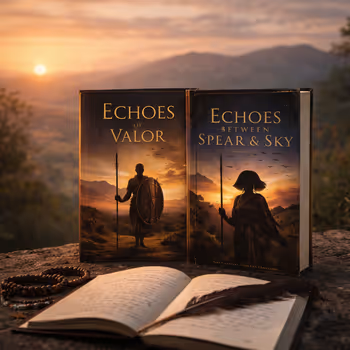
If you would like to explore this lyrical companion and the novel that inspired it:
👉 Echoes Between the Spear & the Sky
Thank you for walking this path with me as the Mekatilili narrative continues to grow, across prose, poetry, and the shared work of remembering.
0 Comments
Leave a comment