

When I first encountered AI writing tools four years ago, I fell for the same fallacy many creators still believe: that large language models are only useful for high-volume content churn.
I leaned on them as a crutch, using them to speed up drafts but not to elevate strategy.
Over time, however, I discovered that AI’s true value lies not in doing the work for you, but in helping you think sharper, faster, and more strategically.
Today, AI is my force multiplier.
It amplifies my ideas, challenges my assumptions, and refines my approach.
It’s my sounding board, not my replacement.
🧭 Brainstorming with a Partner, Not a Machine
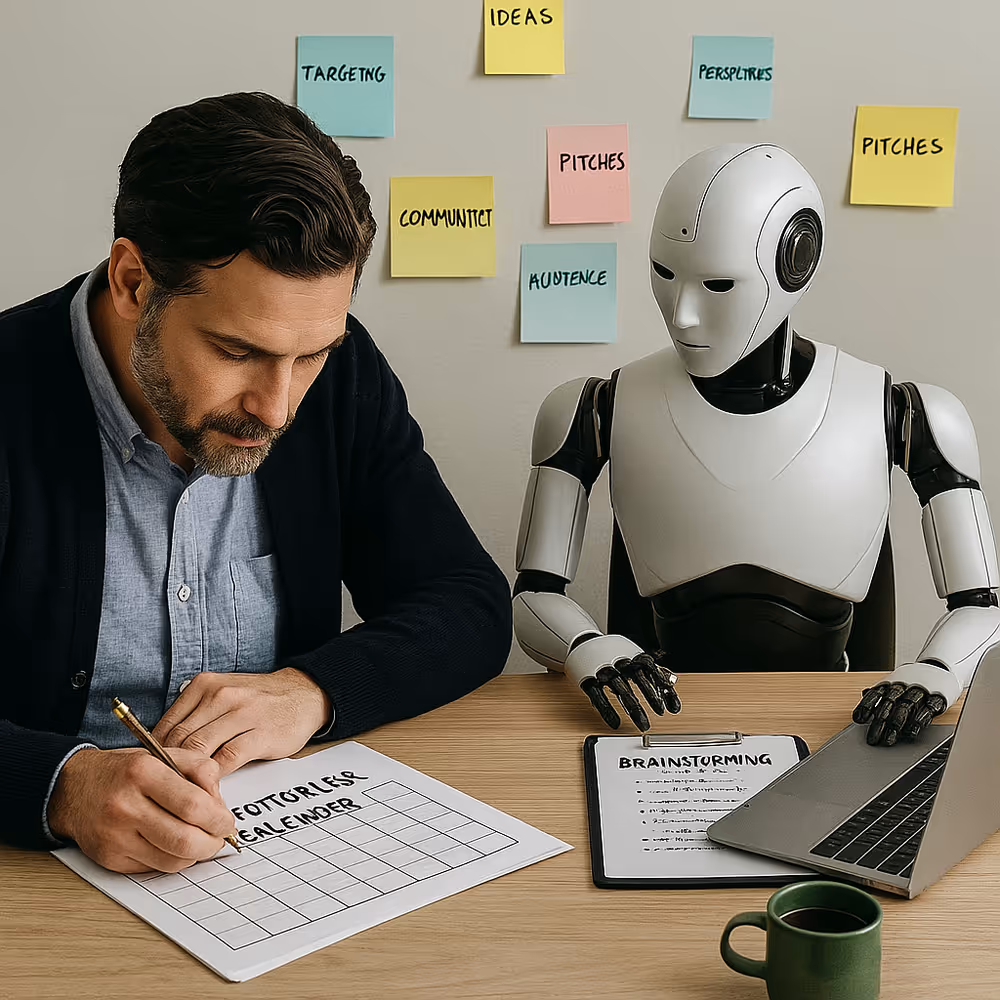
One of the most powerful shifts in my process has been treating AI like a collaborative partner.
I use tools like ChatGPT to:
- 📝 Draft editorial calendars that cover months of content, ensuring consistency and flow.
- 💡 Pressure-test ideas before I pitch them, especially when I need multiple perspectives on a topic.
- 🎯 Refine targeting, so my content isn’t just polished but also laser-precise in reaching the right audience.
For instance, when I was working on Botanical Chemist, Palm Cove, AI-powered brainstorming gave me the confidence to propose ESG-driven campaigns that Tanya Goodwin embraced without hesitation.
The result?
A 10-month editorial calendar that became the backbone of her sustainability messaging.
🌍 Portfolio Pieces That Prove the Point
Over the past three months of daily deliverables, I’ve leaned on AI not to create in my place, but to elevate my voice.
Together, we’ve crafted:
- 🏛️ “The Byzantine Branding Machine” – where history and marketing fused into a bold, unconventional thought leadership piece.
- 🌱 “Net Positive Thinking: Beyond Net Zero” – pushing sustainability narratives beyond clichés with regenerative frameworks like Buen Vivir and Eco-Swaraj.
- 🧠 “Content as Catharsis” – one of my most personal explorations of writing for wellness, strengthened by AI’s structure yet grounded in my lived experience.
- 🌀 “Flow State: How Writing Helps You Get in the Zone” – where AI helped me distill abstract neurodivergent struggles into a digestible, empowering narrative.
Each of these wasn’t just “AI-generated content.”
They were AI-enhanced ideas, infused with my cultural context, anecdotes, and ethical framing.
🖥️ AI in My Digital HQ: briannjenga.co.ke

Building my website has been a laboratory for this human-AI partnership.
From color schemes, layouts, and hero carousels to schema markup for SEO, AI-assisted coding turned daunting tasks into opportunities for creativity.
But the vision, narrative, and user journey: those were all human.
Instead of letting automation flatten my voice, I’ve used it to speed up execution so I can focus on making my work authentic and human.
⚖️ Creativity Can’t Be Outsourced
The biggest lesson I’ve learned?
Creativity is not replaceable.
AI can help me structure, refine, and even challenge my thinking, but it can’t replace the cultural nuance, the empathy, or the lived experience that makes my work resonate.
By putting humans back in the loop, I’m not just producing content.I’m building trust, relatability, and depth.
🚀 Takeaway for Fellow Creators

If you’re still stuck on the idea that AI is only good for pumping out blogs, it’s time to rethink.
Treat AI like a:
- Strategist (for ideation & precision)
- Architect (for structure & workflows)
- Assistant (for execution speed)
…but never a ghostwriter of your originality.
Because at the end of the day, the only irreplaceable part of the process—the part that actually moves people—is you.
💡 Closing Thought: AI hasn’t made me less of a creator.
It’s made me more human in my work by freeing up space for empathy, nuance, and the stories only I can tell.
0 Comments
Leave a comment